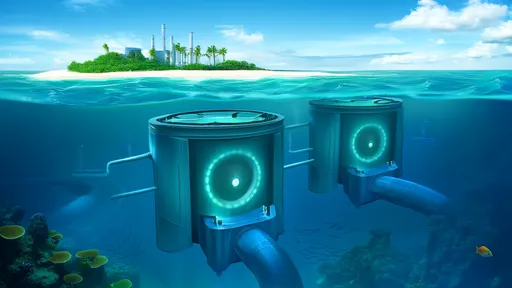
The vast oceans covering our planet hold immense potential for renewable energy, and one of the most promising yet underutilized technologies is Ocean Thermal Energy Conversion (OTEC). For tropical islands blessed with warm surface waters and deep cold currents, OTEC offers a clean, reliable, and sustainable energy solution that could reduce dependence on imported fossil fuels while combating climate change.
Unlike intermittent solar or wind power, OTEC provides baseload electricity—day and night, rain or shine. The principle is simple: it exploits the temperature difference between warm surface water (around 25-30°C in the tropics) and cold deep seawater (about 5°C at 1,000 meters depth) to drive a heat engine. This temperature gradient, typically exceeding 20°C in tropical regions, allows OTEC systems to generate electricity continuously.
The technology comes in three main configurations: closed-cycle, open-cycle, and hybrid systems. Closed-cycle OTEC uses a working fluid like ammonia with a low boiling point, which vaporizes when exposed to warm seawater. The expanding vapor drives a turbine connected to a generator before being condensed back into liquid by cold deep seawater. Open-cycle systems directly use warm seawater as the working fluid—flash-evaporated in a low-pressure chamber to produce steam that spins the turbine. Hybrid systems combine elements of both approaches.
For small island nations, the benefits extend far beyond electricity generation. The cold, nutrient-rich deep seawater brought up during OTEC operations can support secondary industries. Mariculture ventures can cultivate high-value species like lobster, abalone, and sea cucumbers in onshore facilities. The mineral-rich water also shows promise for algae cultivation for biofuels or pharmaceuticals. Some OTEC designs incorporate desalination, providing fresh water—a precious commodity on many islands.
The environmental advantages are compelling. OTEC produces zero direct carbon emissions during operation. Unlike fossil fuel plants, it doesn't release sulfur oxides, nitrogen oxides, or particulate matter that harm both human health and fragile island ecosystems. The seawater intake and discharge occur at different depths, minimizing thermal pollution impacts when properly designed. Moreover, OTEC's baseload capability makes it an ideal complement to other renewables, enabling higher renewable penetration without requiring massive battery storage.
Several tropical locations have demonstrated OTEC's viability. Japan's Saga University has operated a 50 kW demonstration plant in Okinawa since 2013. Hawaii's Natural Energy Laboratory hosts the world's only operational OTEC research facility, where Makai Ocean Engineering's 100 kW system has supplied power to the grid since 2015. French company Naval Energies is developing a 16 MW plant for Martinique, while Lockheed Martin has partnered with Reignwood Group to build a 10 MW facility off China's coast.
Despite its promise, OTEC faces challenges. The technology requires substantial upfront capital—a 10 MW plant may cost $200-300 million. The extensive pipelines needed to draw cold water from the depths present engineering hurdles, especially in deep coastal waters. Biofouling of heat exchangers and corrosion in the marine environment demand specialized materials and maintenance. These factors have slowed commercial adoption, though costs are expected to decrease with technological maturation and economies of scale.
Policy support will be crucial for OTEC's expansion. The technology qualifies for renewable energy incentives in some jurisdictions, but more targeted measures could accelerate deployment. Research grants, feed-in tariffs, and risk-mitigation mechanisms would help attract private investment. International cooperation could pool resources—Caribbean or Pacific island nations might jointly develop OTEC projects through regional partnerships. Development banks could provide favorable financing terms recognizing OTEC's climate mitigation potential.
Looking ahead, OTEC could transform energy landscapes for tropical islands. A 100 MW OTEC plant could power approximately 50,000 island homes while preventing 500,000 tons of CO2 emissions annually compared to diesel generation. As technology improves and costs decline, OTEC may become the cornerstone of blue economies—harnessing ocean resources sustainably. For islands on the frontlines of climate change, adopting OTEC represents both an energy solution and a statement of environmental leadership.
The coming decade will prove decisive. With increasing urgency to decarbonize and improve energy security, tropical nations have a unique opportunity to harness their ocean's thermal gradients. OTEC won't solve all energy challenges, but for suitable locations, it offers a path to energy independence while preserving the marine environments that islands depend upon. As pilot projects mature into commercial ventures, this century-old technology may finally realize its potential as a clean energy game-changer for tropical communities worldwide.

By /Jul 18, 2025

By /Jul 18, 2025
By /Jul 18, 2025

By /Jul 18, 2025

By /Jul 18, 2025

By /Jul 18, 2025

By /Jul 18, 2025

By /Jul 18, 2025

By /Jul 18, 2025

By /Jul 18, 2025

By /Jul 18, 2025

By /Jul 18, 2025

By /Jul 18, 2025

By /Jul 18, 2025

By /Jul 18, 2025

By /Jul 18, 2025

By /Jul 18, 2025

By /Jul 18, 2025

By /Jul 18, 2025

By /Jul 18, 2025